
In September 2024, members and collaborators of the Visual and Material visited Uppsala University for a three-day workshop on Curating Medical Heritage in relation to themes of reconciliation and indigeneity. We started by exploring the photographic archives of the Institute of Racial Biology at Uppsala University’s library, the Carolina Rediviva. Historian and archivist Christel Kraft and Per Widén discussed questions of handling and caring for this collection, making it accessible to the public, meeting visitors, and Uppsala University Library’s relations to the Sámi communities and Sámi parliament. In the afternoon, we were offered the unique opportunity to view artist Katarina Pirak Sikku’s installation Agálaččat bivttastuvvon sohkagotti ivnniiguin/Ihkát ájttegij bájnoj gárvodum/För evigt klädda i ättens färger/ Ihkuven aajkan maadtoej klaeriejgujmie gåårveldihkie/Perpetually Wound in the Colours of the Ancestors (2021), only shown once previously.
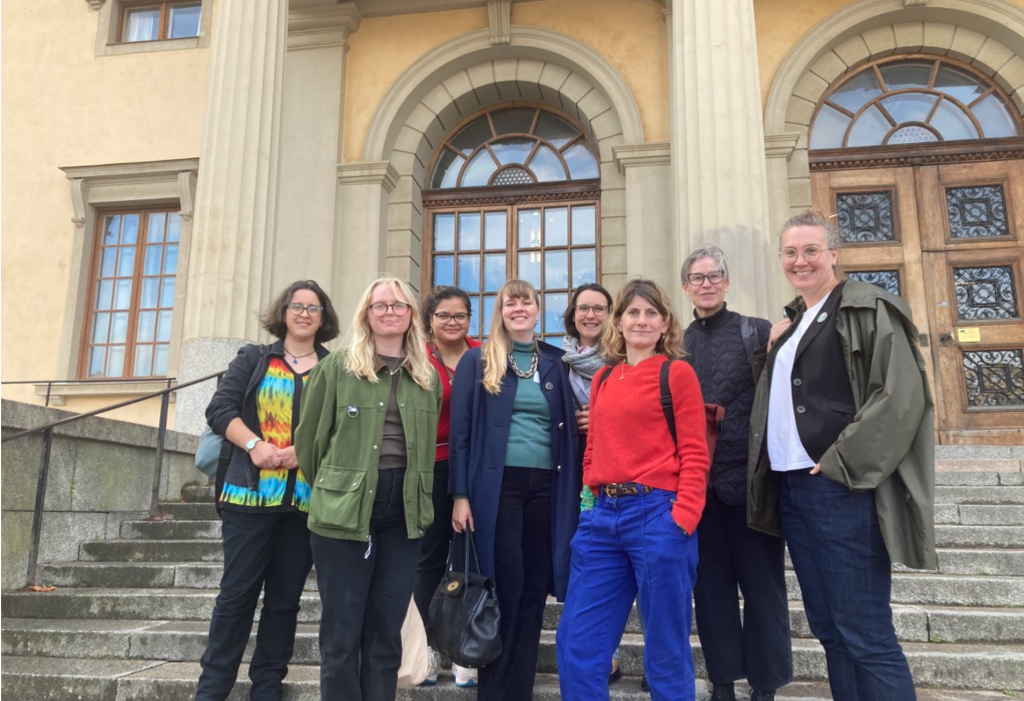
On the second day of the workshop, we travelled to Stockholm to visit the Hagströmer Library at the Karolinska Institutet (a Medical University established in 1810). Researchers and curators Olof Ljungström, Maria Josephsson and Ann Gustavsson discussed recent efforts to repatriate Sámi human remains, including the extraordinary case of the Sámi woman Christina Larsdotter. Finally, Curator Thérèse Toudert gave us a guided tour of the Museum of Medical History in Uppsala, formerly the Ulleråker psychiatric hospital, focusing on the new psychiatry history exhibition. which aims to highlight patients’ experiences.
A full report of the workshop written by Visual & Material Lab collaborator Michaela Clark is available to read on The Polyphony:
The project Curating Cultural Heritage for the Medical and Health Humanities brings together three Matariki Network members, Queen’s, Uppsala, and Durham, to catalyse research collaboration in the globally relevant field of medical humanities. Together the partners will explore how medical cultural heritage, which raises challenging questions about hegemonic ideas of health, illness, and disability, can be sensitively curated to support medical and health humanities research, education, and public engagement towards the goal of increased health equity. It is supported by a Matariki Seed Fund Award (2023-24).


